
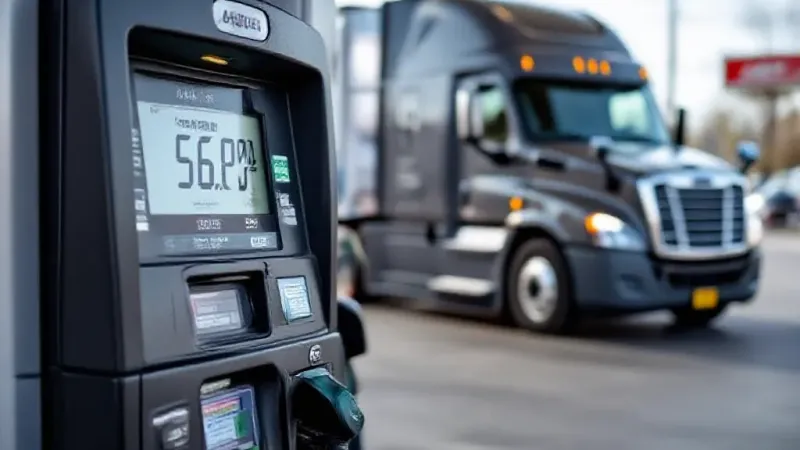
The price of diesel, the fuel that powers much of the world economy, topped $6 a gallon on Friday for the first time ever, according to the latest reading from AAA. This new price point, with the national average hitting $6.06 a gallon, is up 21 cents in just the last week alone.
This marks a significant increase from the previous record of $5.82 a gallon, which was set in June 2022 following Russia's invasion of Ukraine. Since the start of the war with Iran, diesel costs have climbed more than 55%, outpacing a 40% jump in gasoline prices. According to a CNN review of AAA data, diesel is on track for what could easily be the largest annual percentage increase on record.
The surge in diesel prices is attributed to a two-fold problem. First, oil futures have climbed back above $100 a barrel as the US-Iran war continues. Second, there are not enough refineries operating globally to convert crude oil into fuel. Refineries in the Middle East and Russia have sustained damage from war, and Russia, a key source of diesel, has restricted its exports to manage domestic fuel shortages. China has also limited its exports, seeking to prevent shortages within its own borders.
Andy Lipow, president of Lipow Oil Associates, explained the constraint: "Refiners have already been maximizing the production of diesel. We simply can’t get any more diesel out of the system."
While gasoline prices often capture more attention, diesel's impact is widespread. Only about 3% of passenger cars in America run on diesel. However, diesel powers nearly everything else, including heavy trucks, tractors, freight trains, boats, and construction vehicles. Virtually all goods purchased by Americans for their homes are transported by diesel-powered heavy trucks and freight trains.
Major trucking companies and freight railroads typically pass on these increased fuel costs to their customers, such as retailers and manufacturers, through fuel surcharges. These businesses, in turn, may raise prices for consumers to offset their higher expenses. On the West Coast, the situation is particularly acute; the average price for diesel in California stands at $7.98 a gallon. As the nation's largest ports in Los Angeles and Long Beach prepare for an influx of containers for the holiday shopping season, transporting these goods to retailers will cost more, a cost likely to be passed on to shoppers. Patrick De Haan, head of petroleum analysis at GasBuddy, indicated that diesel could "blow past" $8 a gallon in California.
The spike in fuel prices also coincides with the fall harvest season. Diesel is an essential fuel for farming equipment, and higher input costs could lead to increased food prices. Goldman Sachs warned its clients recently that global food prices are at risk of rising sharply. The Wall Street bank cited soaring diesel and fertilizer costs stemming from the Strait of Hormuz crisis, ongoing tensions in the Black Sea that threaten the global grain trade, and the risk of drought and extreme heat associated with El Nino.
Additionally, diesel is virtually indistinguishable from home heating oil, which is used to heat approximately 5 million homes, primarily in the Northeast region of the United States, including about half the homes in Maine. Consumers who rely on heating oil for their homes are likely to face "quite a sticker shock" when they receive their first delivery for the season, as noted by Lipow.
With global oil prices recently closing at $107.63 a barrel, average diesel prices in the US are projected to continue climbing, potentially reaching as much as $7 a gallon, according to Lipow. This diesel spike has already cost Americans more than $46 billion since the war in Iran began, which amounts to over $350 in higher costs per US household, according to a cost tracker from Brown University's Watson School of International and Public Affairs.