
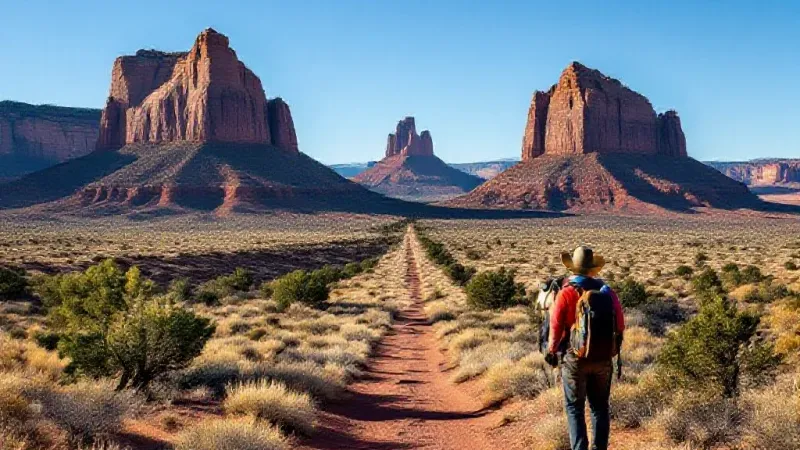
Conservationists and tribal coalitions presented poll results Wednesday suggesting broad public support in Utah for restoring the original boundaries of Bears Ears and Grand Staircase-Escalante national monuments. The findings come from an August poll commissioned by the Grand Canyon Trust, an organization among many that are suing President Donald Trump over his recent decision to shrink the two monuments.
During a virtual news conference, advocates reported that 66% of 500 Utah voters surveyed believe that greater protections for the monuments should be reinstated to their prior boundaries. This sentiment was shared by a majority across various political affiliations and geographic areas within the state. The results follow another Utah poll conducted in the same month, which indicated 56% opposition to the monument reductions, as reported by the Deseret News.
The announcement comes after President Trump’s July decision to reduce the size of both national monuments by 90%. His order also disbanded the Bears Ears Commission, which had been established by then-President Barack Obama in 2016 and managed the Bears Ears monument in partnership with the federal government. This collaboration was considered historic and a potential model for other protected public lands.
The former Bears Ears Commission included representatives from five tribal nations: the Hopi Tribe, Navajo Nation, Ute Mountain Ute Tribe, Zuni Tribe, and Ute Indian Tribe. Davina Smith-Idjesa, a Navajo Nation representative and co-chair of the Bears Ears Inter-Tribal Coalition, emphasized that this collaborative framework was more than symbolic. Smith-Idjesa highlighted its importance for respecting tribal sovereignty, incorporating indigenous knowledge, and acknowledging the enduring responsibilities tribal nations have held for these lands.
President Trump’s order replaced the commission with an advisory committee. This new committee is intended to include representatives from the five tribal nations, along with members from neighboring municipalities and others selected by the governor to represent specific interests, such as archaeology, ranching, and recreation. While the order stipulated that Interior Secretary Doug Burgum and Agriculture Secretary Brooke Rollins “have no obligation to engage, consult, or coordinate with” the now-terminated Bears Ears Commission, it did direct them to “consult with Tribal Nations in accordance with other applicable authorities.”
The poll also explored Utahns' views on the importance of tribal involvement in managing public lands that contain sacred or culturally significant sites. New Bridge Strategy, the research firm that conducted the poll, prefaced this question by noting the prior collaborative agreement between Native American tribes, the U.S. Forest Service, and the Bureau of Land Management for Bears Ears, and that tribes were not consulted before the recent reduction decision. In response, 82% of those surveyed said it was important for tribes to have a strong role.
Autumn Gillard, coordinator for the Grand Staircase-Escalante Inter-Tribal Coalition, commented on these results, stating that they indicate broad support throughout Utah for ensuring that tribal nations have a meaningful and lasting voice in matters concerning national monuments. Gillard told reporters that excluding tribal nations means that generations of knowledge about the land are not considered. She added that the findings are “profoundly telling” and should not be ignored.
Conversely, Republican leaders in Utah, including Gov. Spencer Cox, Attorney General Derek Brown, Senate President Stuart Adams, and House Speaker Mike Schultz, have previously criticized the creation of Bears Ears and Grand Staircase-Escalante national monuments by Democratic presidents, arguing that the protections were too extensive and lacked local community approval. These state officials applauded President Trump’s orders in July, issuing a joint statement that said, “Monument management will bring together representatives from tribes with historic connections to the areas, local governments, and the state to help guide decisions.”
Organizations such as Patagonia and other environmental groups have also revived existing legal challenges against the recent reductions to Utah's monuments.