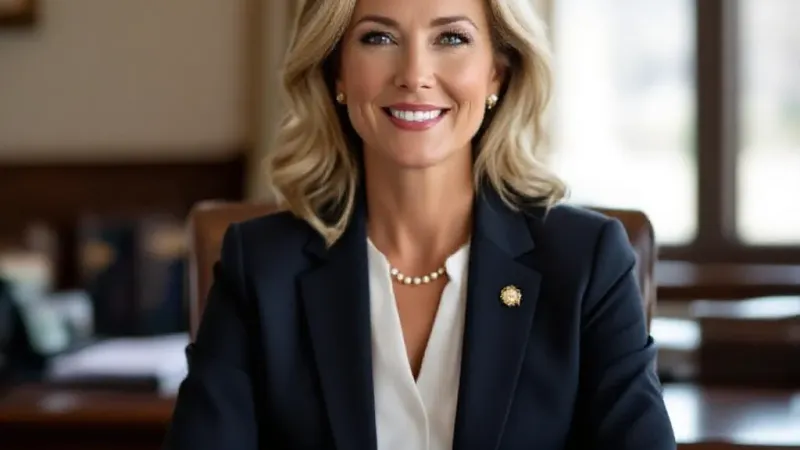
Lt. Gov. Deidre Henderson, Utah’s chief election officer, was informed last week by the U.S. Department of Justice (DOJ) that she is under investigation. The notice came as a surprise to Henderson, who has been a vocal top elected official in refusing to release private voter data, despite prior threats of criminal prosecution from the agency.
According to Henderson’s social media post, the DOJ’s letter, sent last Friday, states, "As you are aware, you are currently under investigation and ongoing litigation as to the extent to which you have failed to comply with your duties." The letter cites the Civil Rights Act, the National Voter Registration Act, and the Help America Vote Act. It also requires Henderson to preserve election records for the past 22 months. Eric Neff, acting chief of the Civil Rights Division’s Voting Section, warned in the letter that "Your failure to preserve relevant data may constitute spoliation of evidence, which may subject you to civil and criminal sanctions."
The DOJ letter claimed Henderson had received notice of the investigation through correspondence to her office in 2025 and the lawsuit the department filed against Utah and other states "for failure to produce their full voter registration lists upon request." Henderson, a Republican, responded to this claim in her post, saying, "Um, no, I was not aware, but I guess I am now." She further commented, "It would be nice if the good folks at the DOJ would focus on actual problems instead of baselessly harassing election officials."
This investigation is part of a broader effort by the Trump administration to obtain copies of voter lists from states, which it describes as necessary for election integrity. While some states have turned over this sensitive data, most, including Utah, have declined to release all information on their lists, citing state and federal privacy laws. Henderson has previously stated that "neither state nor federal law entitles the Department of Justice to collect private information on law-abiding American citizens." She has also assured Utahns that her office will "always follow the Constitution and the law, protect voters’ rights, and administer free and fair elections."
A review conducted by Henderson’s office confirmed that noncitizen voting is not a widespread problem in Utah. This finding aligns with a state audit, as noted by Utah House Minority Leader Angela Romero, D-Salt Lake City, who stated that "99.72% of Utah’s registered voters are verifiably U.S. citizens."
Utah law permits the release of certain voter information for a fee, including name, address, age range, party affiliation, and history of election participation. However, other personal details, such as social security numbers, full birth dates, and driver’s license numbers, are "strictly private for all voters and may only be disclosed to government entities for election administration purposes," according to the Utah lieutenant governor’s website.
Gov. Spencer Cox issued a comment supporting Henderson on Thursday, stating that "Legal disagreements between Utah and the federal government should be resolved in court." He added that it is "wrong for the DOJ to investigate or threaten the lieutenant governor for carrying out her responsibilities under Utah law." House Minority Leader Angela Romero also supported Henderson, thanking her "for standing up for the people of Utah and defending our democratic institutions." Romero emphasized that voter fraud is not a significant issue in Utah and praised Henderson's commitment to protecting voter privacy, which she said "helps ensure that people can participate in elections free from intimidation, political pressure, or fear that their personal information will be misused."
In a related matter, Henderson, along with state and local election officials from several other states, signed a court brief asking the U.S. Supreme Court to block a new U.S. Postal Service (USPS) rule. This rule restricts mail-in ballots for federal elections, establishing new ballot design requirements and mandating that states collect certain voter information to share with the federal government. The litigation surrounding this rule has seen various developments, but as of Thursday, the First Circuit Court of Appeals decided to block the Postal Service from enforcing key parts of the rule. CBS News reported the court argued the Trump administration failed to demonstrate the rule would not cause "chaos and widespread voter disenfranchisement" if implemented before the November elections. A Supreme Court ruling on this matter is expected soon.
The election officials, in their brief, did not take a position on the Postal Service’s statutory authority to establish the rule. However, they contested the practical impact of enforcing the regulation ahead of the 2026 midterms. They noted that absentee ballots have already been sent in some states. Implementing the rule would also require substantial work from Postal Service and state and local election staff, including building and testing new systems for voter data and ballot processing. The officials warned that attempting to implement the rule now "will now almost certainly lead to mistakes, delays, and confusion for both voters and election officials."
While the Supreme Court indicated in late August that the Trump administration is likely to prevail in a case where 23 blue states sought to stop the executive rule, Henderson stated this decision "has no effect on Utah," as an injunction against the rule stemming from a different lawsuit remained in place. Utah clerks also expressed that it is too late to implement such a regulation for upcoming elections. The brief highlighted that the necessary work to implement the rule smoothly cannot be responsibly accomplished in the remaining time without disrupting other crucial election preparations.