
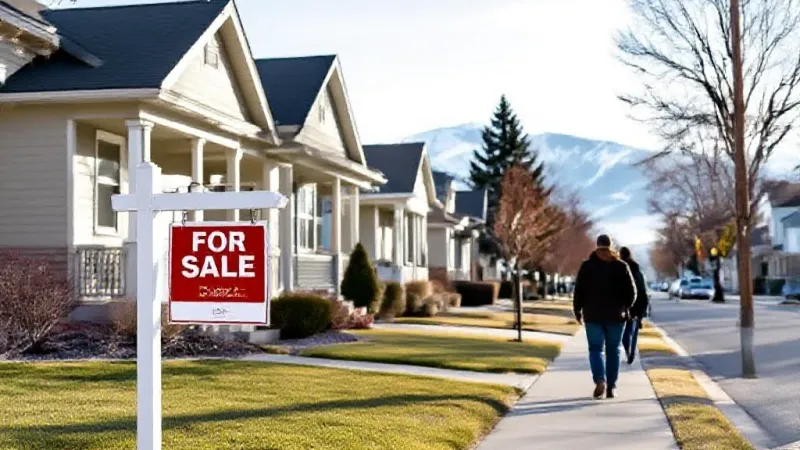
A new report released Wednesday by University of Utah housing researchers indicates that Utah’s housing market remains among the nation’s top 10 most expensive states for single-family homes, with a median price of $559,900 in early 2026. Homeownership is increasingly out of reach for many Utahns, particularly first-time homebuyers, as affordability challenges persist.
The report highlights that the median sale price across all housing types in Utah increased from $500,000 in the first quarter of 2025 to $520,000 in the first quarter of 2026. To afford a median-priced home, an annual income of nearly $150,000 is now required, according to the researchers.
The estimated monthly payment on a median-priced home reached a high of $3,725 in 2025 before slightly dipping to $3,669 in early 2026. This figure is more than $1,200 above monthly payments recorded in 2021. The vast majority of Utah renters, a striking 91%, cannot afford this mortgage payment. Less than 5% of homes sold last year were affordable to renters earning the state's median salary of $64,000.
Researchers predict that Utah’s tight housing market and its affordability problems will continue to persist, and potentially worsen, as mortgage rates remain elevated and are not expected to change soon. The state's population is projected to grow to over 4 million by 2035, requiring an additional 280,000 housing units. Of these, approximately 61,500 will be needed for new owners and renters aged 35 and younger, 120,000 for those aged 35 to 64, and about 98,000 for those 65 and older, researchers state.
The report, authored by Dejan Eskic and Moira Dillow with the University of Utah’s Kem C. Gardner Policy Institute, was discussed during a panel at the Thomas S. Monson Center in Salt Lake City on Wednesday. Eskic and Dillow were joined by other panelists, including Steve Waldrip, senior housing adviser for Gov. Spencer Cox; Springville City Administrator Troy Fitzgerald; and Steven Bond, founder and CEO of the nonprofit HomeOwnership4U.
Panelists discussed the report’s findings and potential solutions to Utah’s housing crisis, agreeing there is an appetite for smaller single-family homes on smaller lots. This contrasts with Utah's current trend; the state is among those with the largest homes for sale in the country, averaging more than 2,400 square feet, as the Deseret News recently reported.
Moira Dillow noted that Utah’s household size is shrinking, projected to decrease from about 2.9 persons per household today to about 2.6 in the next decade. Dillow explained that this decrease in household size will increase housing demand by 11% in the next decade, even with the same population growth. She stated, "Smaller homes are OK because our household size is shrinking as we age."
Dejan Eskic, also the chief economist for the Salt Lake Board of Realtors, and Steven Bond echoed concerns about Utah's average home square footage being significantly high compared to other states. Bond commented, "We’re the largest by square footage per home by a large degree." He added that while Utah has historically built large homes for large families, "it’s time to think about … smaller homes on smaller footprints to make it more attainable" given the current strain on household size.
The Utah Legislature has recently provided tools for cities to incentivize developers to build smaller "starter homes," though it stopped short of sweeping mandates. However, Springville City Administrator Troy Fitzgerald indicated that these incentives have not yet translated into widespread development. Fitzgerald stated that Springville has over 2,000 lots available for development with sizes of 3,000 square feet or less, but "very few of them are coming out of the ground." He further explained that developers are asking the city council to increase home sizes on these lots, presumably due to market demand.
Steve Waldrip acknowledged the challenging data in the report, finding it "hard not to be a little bit depressed." He emphasized the need for "a lot of homes," despite Utah facing "land constraints" between the Great Salt Lake and the mountains. Waldrip concluded that this necessitates "smaller homes on smaller lots."